Towards A Compositional Data Architecture
Coming from array tiles in Bremen to category-theoretic databases
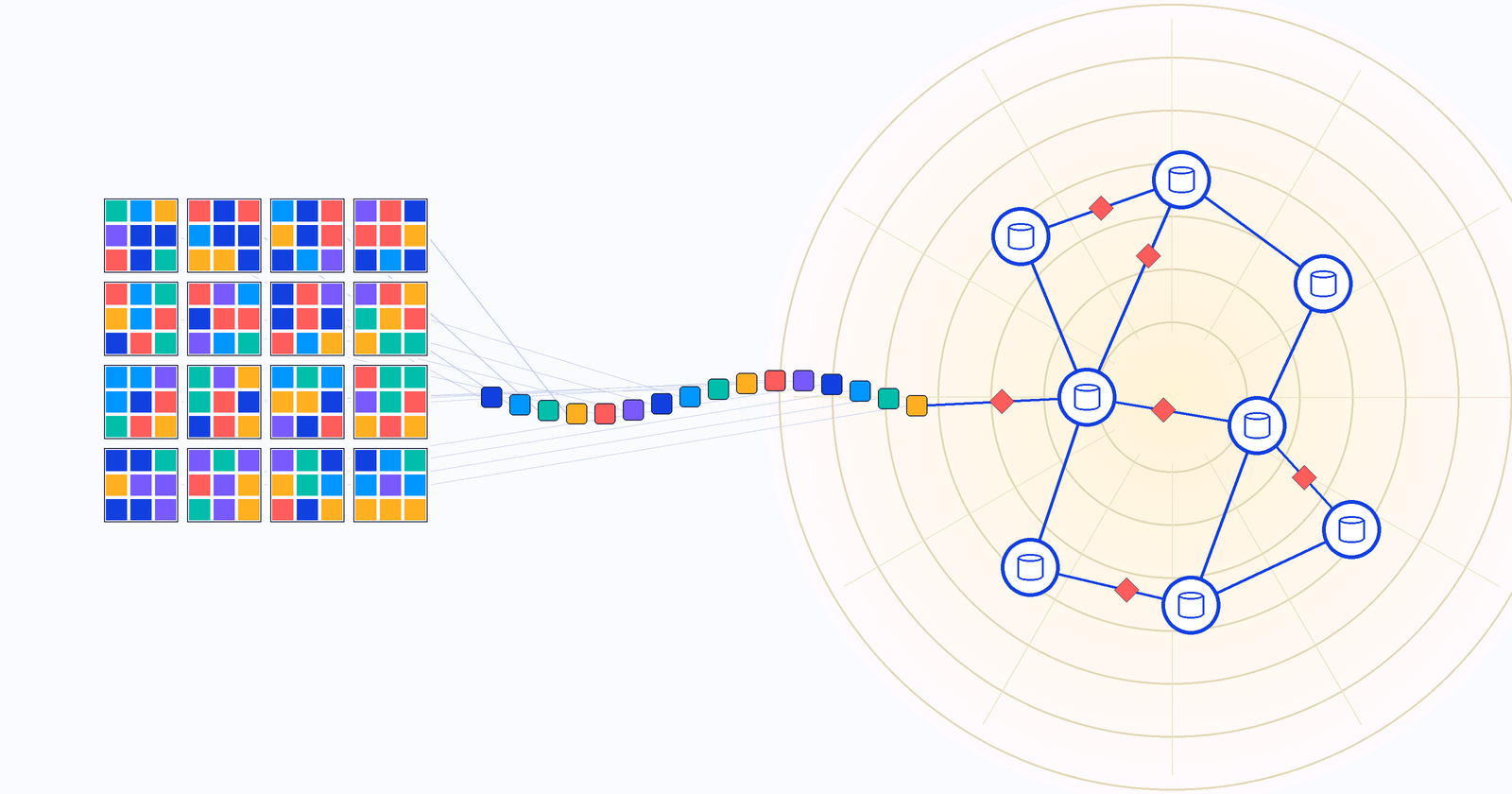
A corollary I carry: we are only ever exploring ourselves exploring the universe.
Keywords in relational terms
The words I reach for when I talk about data come from functional programming and distributed systems: profunctor optics, CALM and monotonicity, anarchic collaboration. In relational terms they map onto updatable views, queries that only gain tuples as more data arrives, and parties that each keep their own relations with no coordinator above them.
The ideas behind those keywords already run inside working systems of record, so the fullest translation I could write was to set those systems beside each other. Optimystic with Quereus, from the GotChoices projects, puts a SQL engine with lenses on top of a peer-to-peer block store. SQLite keeps a single file per machine, and a portable query plan can travel to wherever that file sits. CouchDB, with PouchDB in the browser, keeps documents that are each ACID on their own and replicate between servers and clients.
My data architecture work rests on a thesis that links these systems to an older one. SQLite with Substrait and DataFusion carries the architecture of rasdaman, the array database I worked with in Bremen, across distributed nodes. The tiling and the array algebra stay. Each persistence node keeps its tiles in SQLite, a query plan written in Substrait propagates over the graph of persistence nodes to wherever the tiles sit, and DataFusion on each node runs its share of the plan and passes partial results along for combining. The planning that rasdaman did on a single server now travels with the plan. In a degenerate sense a table counts as a tile too: an array along a single dimension, its key, held whole, so the same plans run over relational tables and gridded data.
My own intuition for those keywords grew up on arrays and functional programming.
Where relational and functional people meet
SQL and relational-model people came to love declarative programming, and so did functional programmers. Relational people work with relations and relational algebra. I worked with matrices, array algebra and one-dimensional folds of multidimensional objects. Functional programmers work with graphs and the many structures a graph can encode, and the relational model overlaps them there. Tables and tuples serve well, and other structures and hyperstructures help too.
A relation over n domains can be read as a set of hyperedges, each tuple joining a value from every domain. Its Levi graph turns each hyperedge into a node linked to its members and gives the incidence view of the same data. The functional and relational traditions had already met in comprehensions, from Wadler's monad comprehensions to LINQ.
Lenses bring in the update side. A view with a rule for writing back through it obeys the laws of a lens when what you write is what you read back and writing back what you read changes nothing. Bohannon, Pierce and Vaughan typed relational lenses in 2006, and the relational tradition had treated views as update targets well before that, in Date and Darwen's Third Manifesto and in Dataphor. A union view routes each write to the branch that accepts it, the way a prism picks a case, and a restriction view admits only the rows its predicate accepts, which is how a filtered optic behaves.
CALM sorts the relational operators by what a late tuple can do to them. Restrict, project, join and union can only gain tuples as more arrive. Difference, NOT EXISTS, key checks and deletes can be overturned by a tuple that has not arrived yet. A program built only from the monotone operators reaches the same answer on every machine without coordination. Anarchic collaboration, in these terms, has parties keep their own relations and combine them through the monotone operators, calling on an authority only for the operators a later tuple could overturn.
When each tuple carries a value from a semiring, such as a count, a probability or a provenance term, a relation behaves like a sparse array. A join followed by a projection then multiplies matrices, and GROUP BY with an aggregate folds along one axis, as Green, Karvounarakis and Tannen showed in 2007. My side of that crossing began in Bremen.
Bremen
I had just switched from Applied Computational Mathematics to the computer science department at Jacobs University Bremen, working with array databases. Scientific data arrives as grids, climate model output and satellite scenes among them, and scientists query it by neighbourhood. A relational table holds an unordered set, so a grid cell stored there becomes a row carrying its own coordinates. An array database such as rasdaman keeps position as an offset and keeps nearby cells together in tiles.
My thesis research presented at the EGU General Assembly in 2014, Unified Access Architecture for Large-Scale Scientific Datasets, coupled Hadoop, Matlab, R and ScaLAPACK to rasdaman through user-defined functions that pass data back and forth with the query. Underneath it sat the step I remember best, flattening multidimensional tiles into one-dimensional tuples. Each tile became a record keyed by its position laid out along a single dimension, with its cells as a flat list that every one of those tools could read.
That August I also drew a research grid with collaborators under the name Co-Planetary Systems, published here as The Matrix, Then and Now. Its core reads like a specification for a record: nodes keep their own records, data is append-only, and collaboration runs peer to peer whatever the network underneath.
The systems I was comparing each settle what a record is in their own way. In Optimystic it is a block. A collection is a tree of versioned blocks, each with a chain of revisions, and a Quereus table over it stores each row under its primary key as the tree key. Quereus's own sync layer replicates at the grain of rows and columns. SQLite's record is a single file, which travels whole, as changesets or as pages of its write-ahead log. CouchDB keeps a document with every revision in a revision tree, and PouchDB keeps the same tree in a browser.
The answer I hold now grew out of that grid in Bremen: a signed record, appended to the log of the party that wrote it.
Moving the tools to the data
The unified access architecture moved the tools to the data. A query could embed routines from Hadoop, Matlab, R and ScaLAPACK through user-defined functions, so the arrays stayed in rasdaman and only arguments and results crossed the boundary. Each tool stayed opaque behind its function, and composition happened at the interface. An engine still sat above the tools, since the array database's query called each of them and gathered what came back.
The systems move different things between machines. An Optimystic transaction travels as its SQL statements, its read dependencies and the block operations they produce. Validators in each affected cluster re-run the statements through Quereus, check that their schema hash matches, and sign promises before anything commits. SQLite moves changesets or log pages, and a portable plan format such as Substrait lets a query travel to wherever the file sits. CouchDB moves documents and their revisions over an HTTP replication protocol that PouchDB also speaks, so a browser replicates directly with a server.
In what I design now, records and the views derived from them travel between parties, plans go to where the records are, and nothing sits above the parties to call them.
Computing over grids and tiles
Quereus treats a logical table as a lens over storage. Reading runs a query over the basis tables, writing pushes the change back down, and the engine checks the lens laws at deploy where it can prove them. Its materialized views stay current inside the writing transaction, row by row where the shape allows and by a rebuild where it does not. When another machine commits to an Optimystic table, the plugin rebuilds the affected views, because a log entry does not reliably carry the old row.
SQLite views are read-only unless triggers write through them. CouchDB builds map/reduce views incrementally and may reduce partial results again, so its reduce function has to give one answer in any order and grouping. Quereus asks the same law of an aggregate's merge.
Relational algebra can already multiply matrices. A matrix A stored as a relation A(i, j, a) holds a tuple for each non-zero entry, and a matrix B stored as B(j, k, b) shares the index j with it. Joining them on j pairs each entry in a row of A with each entry in the matching column of B, and grouping by i and k with a sum adds up those products:
C(i, k, c) = γ[i, k; c = SUM(a · b)] ( A(i, j, a) ⋈ B(j, k, b) )
SELECT A.i, B.k, SUM(A.a * B.b) AS c
FROM A JOIN B ON A.j = B.j
GROUP BY A.i, B.k;
With semiring annotations the same query gets shorter. The join multiplies the annotations of matched tuples, and projecting the join onto i and k adds them, so the projection alone yields the product. Zero entries never appear as tuples, which is why sparse matrices suit this form.
Rotating values works through the same query. A rotation by an angle θ in the plane becomes a small relation R(r, c, v) holding cos θ, -sin θ, sin θ and cos θ, and joining it with points P(p, c, x) on the coordinate c, then summing by p and r, gives the rotated coordinates. Composing rotations runs the same query between rotation relations, and a quaternion rotation can be expanded into its matrix and applied the same way.
Rotating the grid itself moves indices and leaves values alone. A transpose renames (i, j) to (j, i), and a quarter turn of an n × n grid sends (i, j) to (j, n - 1 - i), so both run as projections that compute new keys, with no join or aggregate at all.
Written as joins and aggregates, matrix products run far behind array and tensor kernels on dense numbers and hold their own on sparse, small or keyed data, mostly because the data never leaves the database. The split between AI compute and storage follows density and the semiring in use.
| Finding | Source |
|---|---|
| A 1000 × 1000 product in tuple form passes through about 1000 join tuples per output entry before aggregation | The Duck's Brain |
| Relational neural-network training on MNIST reached about 25 GiB per iteration, against under 5 MiB for arrays; PostgreSQL did not finish within a day | The Duck's Brain |
| opt_einsum beat SQL on large dense tensors; SQLite ran about 2.5 times faster than opt_einsum on many small ones and handled more than NumPy's 32 dimensions | Einstein Summation in SQL |
| Planning one large query took PostgreSQL 1.51 s and SQLite 0.03 s; DuckDB's optimiser had not finished after five hours, and with optimisations off the query ran in 0.97 s | Einstein Summation in SQL |
| A sparse matrix-vector product over 500 million non-zeros on a 16 GB laptop took DuckDB 23 s and SQLite about 500 s | factbased, via R-bloggers |
| Running joins and group-by aggregates on tensor cores gave up to 288 times the speed of a GPU query engine | TCUDB |
The planning figures favour portable query plans, since a plan decomposed once and shipped to where the data sits skips the optimiser that cost the most. The cell-per-tuple blow-up also explains why the tiles from Bremen still matter. With a tile as the tuple, a product joins tiles on the shared inner index, multiplies each pair with a dense kernel and sums by output tile, so the join runs once per pair of tiles. Recent work on tensor-relational Einstein summation arrives at the same split, keeping sparsity relational and sending dense blocks to numerical kernels.
Scientific data still needs the ordered layer. At this year's EGU General Assembly, the same meeting where I presented my thesis research, climate centres describe the separation between data location and compute as a barrier and serve archives as Zarr chunks over the web. Space-filling curves keep spatial neighbours close in key order, so a box query becomes a handful of short range scans, as long as the key is fixed-width and keeps its order when encoded.
Time, Ordering and Clocks drawn as angles
I wrote Time I and Time II in 2020, on the semantic and existential crises of time. Time II draws circular time in polar coordinates, with clock hands as angles, and argues that angles on a Cartesian system and the polar picture both map without loss onto a straight, one-dimensional timeline.
Time III, published this year, takes up quaternionic time through the Cayley-Dickson layers. Hamilton read the quaternion as time plus space, a scalar beside a vector. From that line of work I took an encoding of space in time and wrote my own identifier generator for it, a duct-taped one before UUIDv7/ULID existed.
With those identifiers I benchmarked ways to flatten structure. A hypergraph went into its Levi graph, with an identifier on every node and every hyperedge, and came out as flat text appends. Grids went along space-filling curves, over polar and over Cartesian logical grids.
Time III also settled a point about logs. A finite log has the same shape as its reverse, and a log that never ends takes its arrow from the rule that it only grows by appending.
The systems find their order in different places. Optimystic orders each collection's transactions through the cluster at the tail of its log, which gathers signed promises and runs a two-phase commit. Its design notes on CRDT sync explore replacing that sequencer with hybrid logical clock order and deterministic replay, and Quereus's sync layer already orders column writes by hybrid clock, last writer winning. SQLite has one writer per file, so its order follows that writer's commits. CouchDB keeps every revision in a tree, picks a deterministic winner when branches conflict, and keeps the losing branches for an application to resolve.
The order I ask for is each party's own append order, with no global order until a step depends on something being absent.
A ship as a closed system
The political side of that question reached me through work before it reached me through theory. Building software for large cruise lines, I saw a ship as a closed system where one operator runs the space, the schedule, the payment rail and the data. Every record on board passed through the operator's hands.
The prelude to this series, What We Keep and What We Seal, asks which social facts need an authority and which anyone holding the right records can settle. A monotone fact, such as "this reading was taken", only gains support as records arrive. A fact that depends on an absence, such as "no objection remains open", cannot be settled from anyone's own records.
The CALM theorem draws the same line for programs: a program reaches consistent answers without coordination exactly when it is monotone. A seal, such as a chair's declaration or a joint signature, closes a set of records and turns an absence back into something monotone.
Optimystic sorts writes into lanes along that line. A write that a table's declarations allow to replay, keyed by primary key and touching only columns that merge by last writer, can take the convergent lane. A write that touches uniqueness, a foreign key, an assertion or a delete, or that picks its rows by a predicate other writers can change, goes to the coordinated lane, and a transaction across collections commits there. SQLite coordinates everything cheaply, since a file has one writer and every transaction on it is fully ACID. CouchDB makes each document ACID on its own under multi-version concurrency control and leaves anything that spans documents to the application, with conflicts surfacing as branches in the revision tree.
Pat Helland's Immutability Changes Everything names what changes once the writers sit far apart. He argues that distributed systems need immutability to coordinate at a distance and can now afford it as storage gets cheaper, with observations recorded for good, the way accountants keep their books without erasers, and derived results computed from them on demand. A SQLite file updates in place under its single writer, and records that are only ever appended can travel between parties with far less to agree on.
I apply the same line to parties. They coordinate only where a step depends on something being absent, and they pay for it with a co-signature or a witness.
Meaning that drifts
Collaborative Systems in the Age of Codes and Weights, my socioware essay, starts from Husserl's sedimentation and technization: meaning settles in layers and drifts from where it began, and codes and model weights widen the drift. Its answer is distributed self-organization through monotone collaborations. Each party keeps a log of signed entries and an olog of its own terms, and the parties share an ontolog that grows only by addition.
The matrix had already given language a whole column, and Anarchitecture in 2020 asked how managerless teams reach consensus without coercion, with Conway's law in view.
Quereus plans for peers that upgrade at different times. The tables peers share form a basis that never changes in place, each app version carries its own logical schema and lens, and a new representation arrives as a new table derived from the old one. The migration runs as expand, converge, flip and contract, so old and new versions keep reading and writing while the old table retires. Optimystic validators also check a schema hash before they re-run a statement, so peers that disagree on a declaration refuse each other's writes early. SQLite changes by migration, script after script on a file. CouchDB stores schemaless documents, so the application reads every version it has ever written and decides what each field means.
I settled on a lens per version over records that never change, since, as Helland puts it, versions are immutable too. Each reader translates, and the record stays as it was signed.
Roads to SQLite, with Postgres kept in mind
rasdaman, the GotChoices stack and my own designs have ended up in the same place. Each keeps its data in SQLite, a file with a single writer, close to whoever owns it, and each keeps ideas from PostgreSQL in the language and the guarantees around that file.
rasdaman began with a conventional database such as PostgreSQL as its base DBMS, holding the alphanumeric data as relational tables while rasdaman handled the arrays. A later ticket let rasserver use SQLite instead of PostgreSQL. Today the engine keeps its array metadata in embedded SQLite, writes array files to the local filesystem by default, and treats the PostgreSQL BLOB option as deprecated. The language stayed: rasql extends SQL for multidimensional arrays, and the geo service still runs on PostgreSQL.
In the GotChoices stack, Quereus borrows SQLite's shape. Every table is a virtual table, its tests follow SQLite's own testing method and cross-check SQLite's test suite, and a storage plugin can keep all tables in a single SQLite file. Optimystic offers a SQLite backend for NativeScript devices. Its semantics lean toward PostgreSQL: a logical type system in place of SQLite's type affinity, native temporal and JSON types, excluded.* for PostgreSQL compatibility, statistics that go stale in the PostgreSQL autoanalyze shape, materialized views, and lenses in the line of the Third Manifesto and Dataphor.
My own designs keep a SQLite store on each device under hand-written migrations, with CouchDB replicating between servers and PouchDB keeping a replica in the browser. From Postgres I keep the habits I trust most: declared types and constraints, migrations written by hand, and extensions that add new types and operators. I keep wondering whether array algebra over tiles could ride along as an extension, the way pgvector rides on Postgres, so the grid stays where it was recorded.
SQLite settles where the record lives and who writes it, with a file and its single writer beside the person or the instrument. Postgres settles how the record should behave, with types that do not drift, constraints that hold, and a language that extends without changing what it means.
Signatures, scores, and trust as a fibration
Optimystic assumes some peers may lie. A commit needs signed promises from a super-majority of a cluster, peers can dispute a block's validity in cascading rounds, and the network tracks reputation and catches equivocation. SQLite trusts whoever holds the file, and every copy is authoritative to its holder. CouchDB authenticates users and authorises them per database, and replication trusts the server it pulls from.
My own answer went into a paper, Collaboration Is Composition: Mealy Machines over Signed Records in Poly and Org. Each party runs a Mealy machine over an append-only log of signed records, and a collaboration wires machines together through mailboxes into a larger machine that can itself be wired into another. The paper types claims so that only signed records can inhabit them, and an approval signed by the wrong party fails to type-check.
The results follow from known theory and are checked in Lean 4. Bisimilar machines give bisimilar collaborations, and monotone machines converge under any fair delivery order. The paper treats accepting a derived fact as a homomorphism out of a provenance semiring, and it models trust as a fibration over observers, with each observer ranking inside its own view.
A fibration sits over a base. Here the base holds the observers and the relationships between them, such as one party reading another's log or relying on another's signature. Over each observer sits a fibre, that observer's own view: the records it holds and the order in which it trusts them. An arrow in the base, from me to a party I rely on, comes with a way to carry that party's judgements back into my fibre, restated in my terms, and carrying judgements along a chain of such arrows agrees with carrying them along the composite arrow.
A reputation score or a ranking puts every record on a single scale that every observer shares, so trust ends up as a number attached to the record. In the fibration a judgement always belongs to someone. It lives in an observer's fibre and reaches another observer only along a relationship in the base, which says how it translates. Parties holding the same signed records can then trust them differently without either being wrong, each judgement keeps the path it travelled, and a global score appears as the special case of a base with a single observer.
The user-defined functions in Bremen were interfaces where opaque parts met, and in the paper those meeting points became mailboxes. Tiles flattened into keyed tuples turned into logs that any party can extend with a signed record. Bremen still had a query engine calling every tool, and the paper has nobody calling from above, since a collaboration composes into a larger one on its own. Coupling tools across paradigms and output formats came back as a theorem about swapping a part, because a bisimilar machine can take another's place without changing the collaboration.
Folds over flattened grids became each machine's run over its log, convergent when monotone. The line from Time II and the seals from the prelude marked the steps that need coordination. The hypergraphs in the matrix, parties joined by a single relation, came back as provenance for derived facts and trust worked out per observer.
A category-theoretic data architecture
Lenses compose, and a composite obeys the lens laws whenever its parts do. Profunctor optics encode lenses, prisms and traversals so that any of them composes with any other by ordinary function composition. Monotone queries compose into monotone queries, so CALM's guarantee carries through a whole pipeline. A semiring homomorphism commutes with positive queries, joins and unions among them, so provenance survives every step of a query. Category theory studies composition laws like these, and the architecture I arrived at is built from its constructions.
The data layer follows Spivak's work. In ologs, Spivak and Kent write a party's terms as a category, with types as objects and functional relationships as arrows. Functorial data migration presents a schema as a category and an instance as a functor from it into sets, and a mapping between schemas moves data by pulling it back with Δ and pushing it forward with its adjoints Σ and Π. The lens per version from the socioware essay sits in that frame as a schema mapping with checked laws. The shared ontolog grows by adding objects and arrows, so every mapping into the old ontolog still lands in the new one.
Machines sit above the data. Poly represents a machine as a map from its states to its interface, both written as polynomial functors, and Org wires machines into collaborations through diagrams that nest. Bisimulation is a congruence for that wiring, so a part can be swapped for a bisimilar one anywhere in a diagram.
Provenance and trust share the structure. A derived fact carries a term from the provenance semiring, and accepting it maps that term by a homomorphism into a semiring the observer chooses. Observers form the base of a fibration with each observer's view as a fibre, so ranking happens inside a fibre and nobody needs a global ranking.
The storage underneath stays plain. A SQLite file with a single writer holds each party's log, types and constraints in the Postgres manner guard what enters it, and the categorical layer says how logs, views and machines compose across parties.
How others read this site
A reading of this site reached me recently, written from an engineer's seat and from a political one. The engineer noticed habits running through this year's essays. Amnesiac APEs Wearing RAGs asks for a shared epistemic memory that keeps Erfahrung, experience folded into belief, apart from Erlebnis, a bare occurrence. Specs as Laws rewrites Given, When, Then as quantified invariants tested with small adversarial generators and round trips, and several essays prefer merges that commute, associate and ignore repetition.
The political reader asked where trust sits. For How P2P E-Voting fixes E-Voting - I, the reading listed the frictions: resisting fake identities pulls toward state IDs, verifiability can expose voters to coercion, and compromised devices and uneven access tilt who takes part. The readers agreed on a sentence: whatever a system coordinates, its fragility comes from unstated assumptions about shared truth, about authority, and about what happens when parts of it disagree.
The engineer's caution about overhead holds. Ontologies, meta-schemas and laws cost latency, cold starts and ergonomics, and that cost buys assumptions stated where a machine can check them. I try to keep the price small with specifications as invariants checked by small generators, lenses whose laws a test can run, and the benchmark table above to show where a relational form earns its keep.
The political warning lands on the line the prelude draws. Bad faith, capture and coercion are questions about absences, such as whether any forged ballot remains or any objection is still open. By CALM, no party can settle those from its own records, so they need a seal from someone with standing, such as a witness or a court, and who holds the seal stays a political question. Where a ledger is asked to carry trust, a signed append-only database with published hashes does the same job more cheaply and without a ledger's energy cost.
The observer inside the record
Each system of record decides, somewhere, whose view of the data counts. SQLite leaves it to whoever holds the file, CouchDB to a deterministic rule that picks a winning revision, and Optimystic to a super-majority of a cluster. In the paper no view of the shared record exists apart from someone holding it. Each observer computes trust inside its own fibre, and parties holding the same signed records can rank them differently without any ranking being forced on another.
In Bremen the scientist's query reached into the tools. In the paper each party signs its own log and ranks trust from where it stands. Between them, the Time essays kept returning to the distance between an observer and what it observes, which a log measures as the records not yet received. Each observer explores the universe through its own fibre of signed records, so every query it runs also explores the observer running it.
The systems side by side
The table sets each system's answers beside mine.
| Question | Optimystic with Quereus | SQLite with portable plans | CouchDB and PouchDB | Collaboration as Composition |
|---|---|---|---|---|
| What the record is | Tree blocks; rows and columns in Quereus sync | The file, its changesets or its WAL pages | Document revisions | Each party's signed records, appended |
| Where order comes from | Cluster consensus with signed promises; last writer wins by hybrid clock in Quereus sync | A single local writer | Revision trees with a deterministic winner | Each party's append order |
| What has to be coordinated | Writes in the coordinated lane, committed across collections | Everything, inside a local transaction | A document at a time, ACID with MVCC | Only steps that depend on an absence, sealed by a co-signature or a witness |
| What travels | Statements that validators re-run, and blocks | Changesets, or a query plan sent to where the data sits | Documents over the replication protocol PouchDB speaks | Records, and the views derived from them |
| Computing over the record | Lenses over a storage basis, materialized views kept row by row | Views, writable through triggers | Map/reduce views whose reduce must combine in any order and grouping | Folds over each log, with provenance carried into what they derive |
| When the schema changes | A frozen shared basis, with a lens per app version | Migrations | Schemaless documents | A lens per version over shared records, as a schema mapping |
| Whom to trust | Byzantine-tolerant signatures and reputation | Whoever holds the file | Authentication and authorisation | Signatures, with trust worked out per observer |
| How the parts compose | Lenses over a shared basis, transactions through clusters | Inside the file | Per document, with conflicts left to the application | Lenses, functors and wiring diagrams, each with its composition laws |
References
My own work:
- Unified Access Architecture for Large-Scale Scientific Datasets, EGU General Assembly 2014, EGU2014-16290
- The Matrix, Then and Now
- Time II
- What We Keep and What We Seal
- Collaborative Systems in the Age of Codes and Weights
- Collaboration Is Composition: Mealy Machines over Signed Records in Poly and Org, Zenodo, 2026
Systems of record:
- Quereus and Optimystic, GotChoices, their documentation as of November 2026
- rasdaman installation and administration guide
- rasdaman ticket 815: port file storage support with SQLite
- rasdaman in the Database of Databases
Others:
- Schüle et al., The Duck's Brain: Training and Inference of Neural Networks in Modern Database Engines
- Blacher, Klaus, Staudt, Laue, Leis and Giesen, Efficient and Portable Einstein Summation in SQL, SIGMOD 2023
- Large Matrix Multiplication: DuckDB vs. SQLite, factbased via R-bloggers, 2023
- Hu, Li and Tseng, TCUDB: Accelerating Database with Tensor Processors
- Tensor-relational Einstein summation, arXiv 2603.08957
- Freva Data Loader, EGU General Assembly 2026, EGU26-9640
- Bohannon, Pierce and Vaughan, Relational Lenses: A Language for Updatable Views, PODS 2006
- Green, Karvounarakis and Tannen, Provenance Semirings, PODS 2007
- Date and Darwen, The Third Manifesto
- Wadler, Comprehending Monads, Mathematical Structures in Computer Science, 1992
- Meijer, Beckman and Bierman, LINQ: Reconciling Object, Relations and XML in the .NET Framework, SIGMOD 2006
- Helland, Immutability Changes Everything, CIDR 2015; Communications of the ACM, 2016
- Hellerstein and Alvaro, Keeping CALM: When Distributed Consistency Is Easy, Communications of the ACM, 2020
- Clarke et al., Profunctor Optics: A Categorical Update
- Spivak and Kent, Ologs: A Categorical Framework for Knowledge Representation, PLoS ONE, 2012
- Spivak, Functorial Data Migration, Information and Computation, 2014
- Niu and Spivak, Polynomial Functors: A Mathematical Theory of Interaction, Cambridge University Press, 2025
- Shapiro and Spivak, Dynamic Categories, Dynamic Operads: From Deep Learning to Prediction Markets, the paper that defines Org
About the author
- Technical Leadership & Architecture
Comments
Join the discussionNo comments yet. Be the first to comment.
An Architecture
In this series, we explore ways to think about the architecture of common libraries & UIs. We will use JS, Bun, TS, Svelte 5+, Nx, RxJS, ScalaJS, ReasonML, Idris 2+, and Lean 4+.