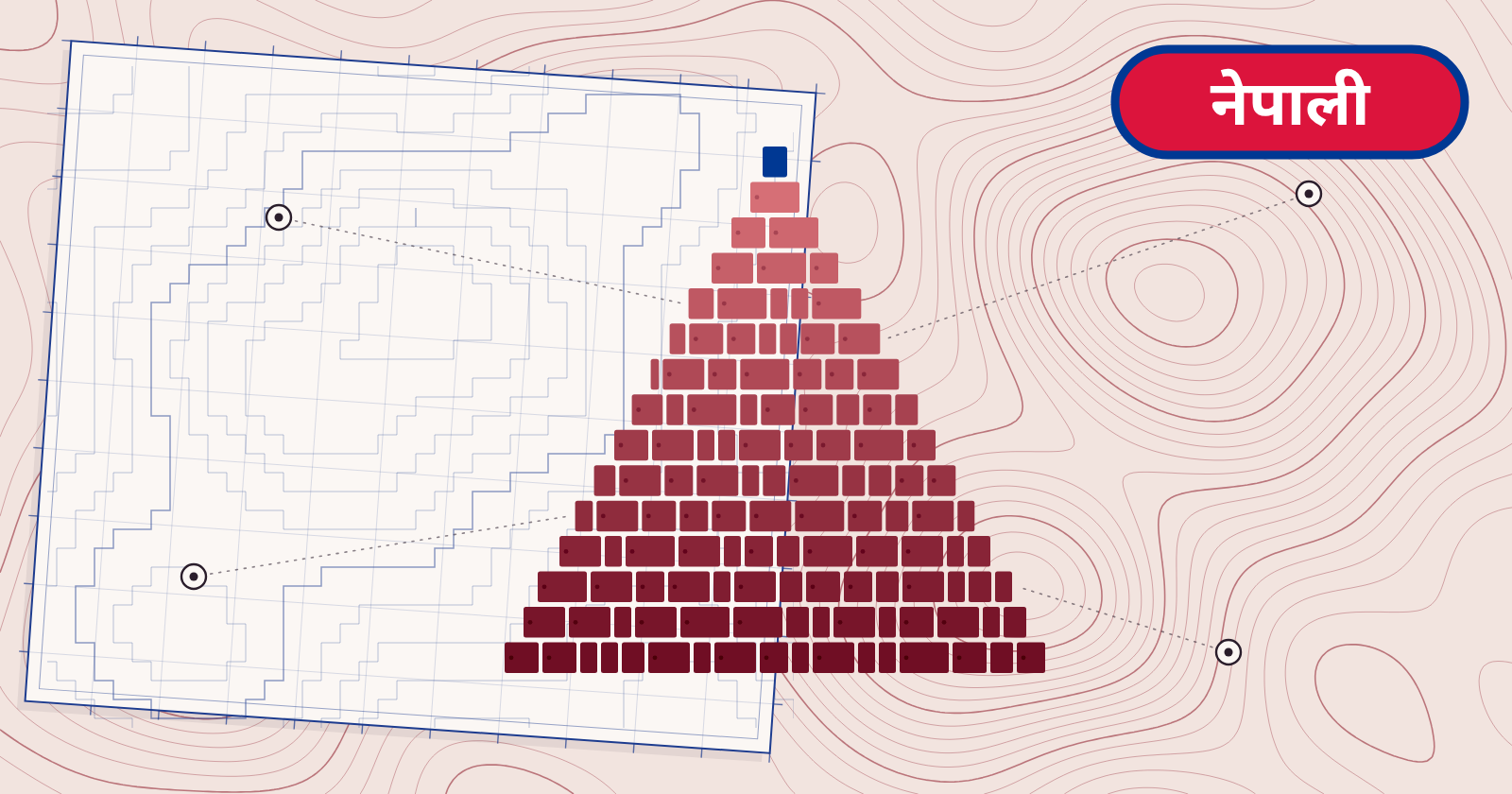
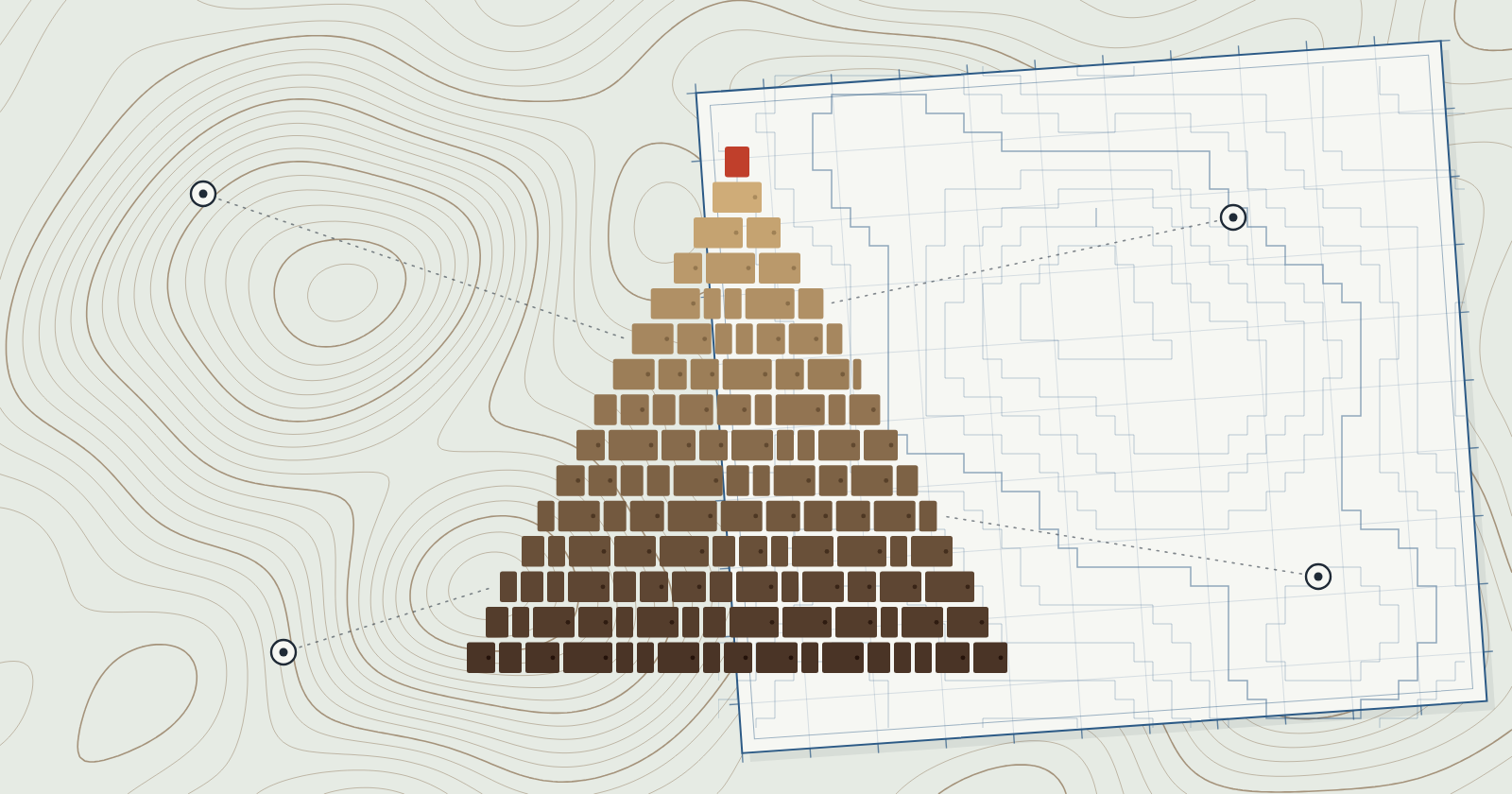
The Matrix, Then and Now
Giants and Atlases, a research map from 2014
Let's look at who keeps records today, and at how they work together. A family spread across countries keeps a parent's care going, often with a son or daughter abroad holding part of the arrangement. A clinic keeps its own folders, a lab its own codes, a ministry its own forms, and a global body sets targets for all of them; numbers travel between them because, as Theodore Porter put it, quantification is trusted where personal trust can't reach. Teams write software together with no manager in the middle, the way Anarchitecture imagined, and models now join every one of these collaborations, fluent and forgetful, holding a context for one call and dropping it by the next, the clipboard I wrote about in Amnesiac APEs Wearing RAGs.
Two kinds of machinery sit between these parties. Codes decide in advance what can be recorded and in what shape: diagnosis codes, units, schemas, protocols. Weights produce whatever can be recorded, on demand. Both let meaning travel without its origin, which is why they are useful; both let it drift away from whoever first saw it, which is the trouble my essay Collaborative Systems in the Age of Codes and Weights follows from Husserl's handed-down triangle to Baudrillard's map that comes before the territory.
The usual answer is a platform in the middle. It holds everyone's records, keeps the codes and the weights, sits outside every chain it serves and still sets the terms, and it can rewrite both whenever its quarterly numbers ask it to. The parties get coordination. What they give up is the one thing that keeps a record honest: being able to take it back to whoever made it and see again what they saw. Signatures and co-signatures can win much of that back without the middle, as the sections below show, though a signature only tells you who vouched for a record and never whether it is true.
So the question underneath all of these collaborations is a plain one. Can people, organizations and their software work together without a middle, over whatever network happens to be up, and still agree on what their records mean?
I first tried to map that question in August 2014, as a twelve-row research matrix I called Giants and Atlases. It was a roadmap for our research in the coplanetary collectives: groups of thinkers, system architects and computer science students. The copy that survives is a PDF from 2015. This post is about why the terrain needed a map, what the map still says about where we are now, and how the series that follows turns it into a curriculum.
A map with two directions
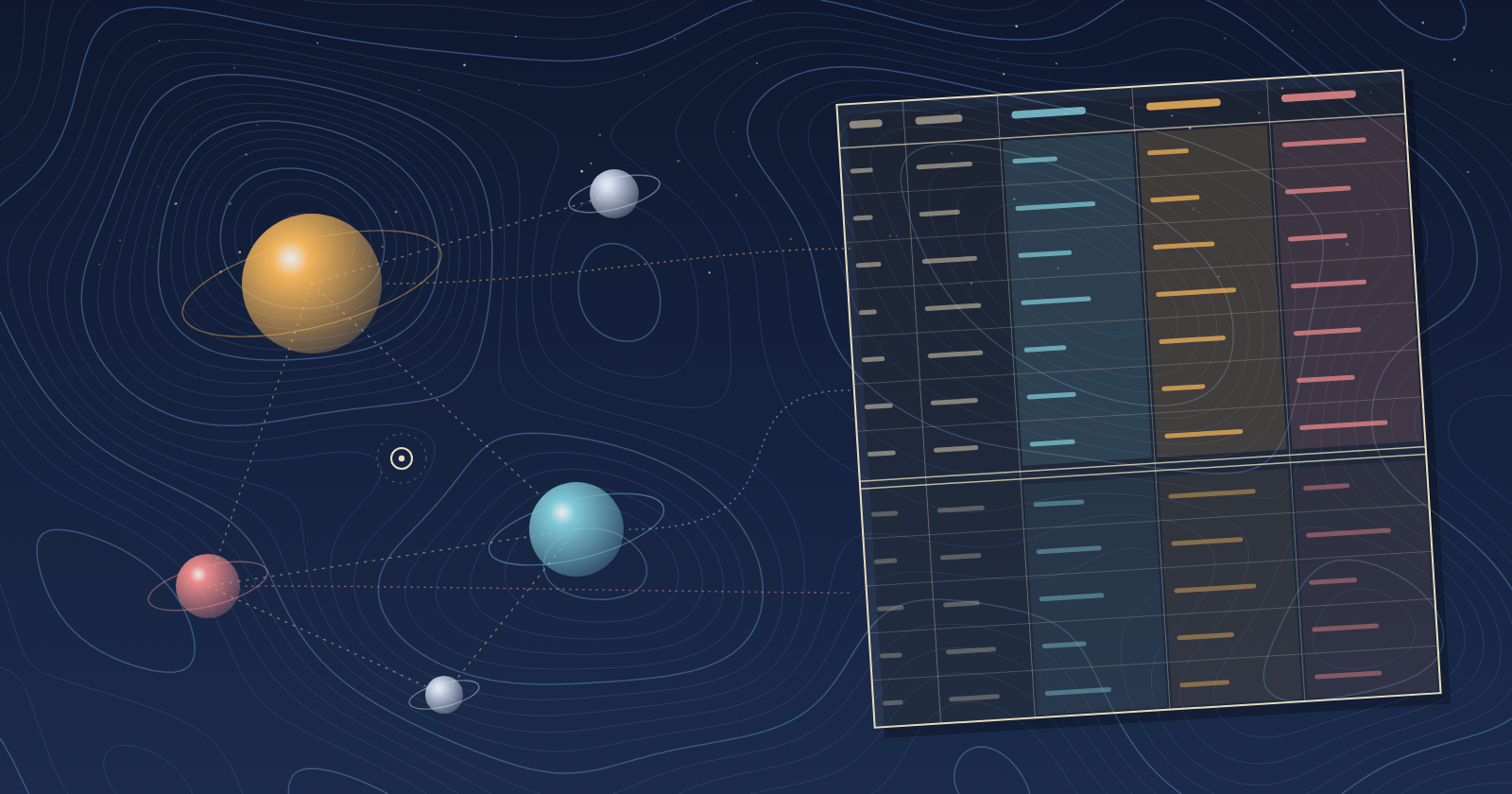
Why a grid? Because the terrain has two directions, and a list only has one. Down the rows, a collaboration climbs: first structure, the parties and the network between them; then meaning, the records and what they stand for; then the collective, the clusters that form, synchronize and gather. Rows 1 to 7 are those fundamentals. Rows 8 to 12 are derived from them, and they are what gets built on top: models and simulations, actions in the world, collaborations near and far, and the discipline that keeps theory and practice equal.
Across, every step has to make sense three times. Language Understanding asks what it means in words, from the smallest unit of text to whole clusters of context. Unified computations asks what it costs when many machines compute as one. Eyes, Minds asks what a mind can hold of it, climbing from models of the brain toward understanding and belief and, at the bottom of the grid, socioware. Two more columns, Concept and Keywords, name each row.
The columns have older names in my writing. Before the matrix, our collective called the traits we were chasing the CURE: context-based retrieval by content, ubiquitous computing and the reasoning engine, which the essay reads against Husserl and Baudrillard. The last column sits close to the title of Merleau-Ponty's last essay, Eye and Mind; every mind in the matrix has eyes, and those eyes belong to a body in a place.
Why planets
The name came from the collective rows. I pictured clusters of context as planets pulling on one another and keeping in sync the way bodies in orbit do, and that picture is half of the reason for the name Co-Planetary Systems. The other half was a longer bet, which the 2014 notes make in one breath: socioware able to answer "physics-limited solutions to problems in real-time communication and collaboration between planets", if we manage to pass the great filter first.
The bet is less exotic than it sounds. Between planets the limit on communication is the speed of light, so a collaboration that works there has to work without waiting on a center. A collaboration that works between planets works anywhere: across a village whose phones come online once a day, across a country, across offices that each keep their own records, across a family whose syncs cross time zones the way the planets' cross light minutes. That is the terrain of internet-agnostic peer-to-peer software, and it was the terrain of the matrix from the start.
Then and now
What does a research map look like twelve years after it was drawn? The terrain it was drawn for has only grown. Every party now keeps records, every record travels, and codes and weights decide more of what gets recorded and of what gets written back.
Going back to the matrix is reactivation in Husserl's sense, the act the socioware essay begins with: digging down through a layer I laid in 2014 and redoing the seeing. What I find at the bottom is the essay's answer, already sketched. The matrix asked for nodes that keep their own records and compose by wiring, for records that stay flat and point at one another, for meanings that keep their makers, for collectives that grow by addition and agree in any order, and for sinks that keep what they hold without ever becoming sources. The essay calls the same structure logs, ologs and an ontolog, and it calls the rule only adding.
That monotone core now has a proof. Collaboration Is Composition models each party as a Mealy machine over its own signed records and shows that when every step only adds, any fair schedule reaches the same state, a form of the CALM theorem; where a step depends on something being absent, the parties settle it together with a co-signature. Nobody has to keep them in step, and nobody in the middle has to hold their records.
The substrate is discrete. Records are signed and never rewritten, merges agree in any order, and some arrows must not exist; that is the shell. Inside it sit the parts that are probabilistic by nature: people, devices that come and go from the network, gossip spreading in rounds, models suggesting a reading, clusters forming and dissolving. The shell limits what they can do without making them predictable, and whatever the core proposes counts only once the shell accepts it. In the matrix I held that probabilistic mechanisms without physics and discrete mathematics in the substrate are not the route to superintelligence. I still hold it. The shape is older than the matrix, too: Kolmogorov put probability inside mathematics in 1933, and the last article in this series comes back to him.
Over people's records I keep the Eyes, Minds column thin on purpose. Nothing about a person is inferred that they did not confirm, and trust travels as vouches that people give one another. The essay names what is at stake in one word, sovereignty, where the real refuses to disappear: whose body, whose land, whose keys.
Reading the series
This post is the first of four. The other three walk down one column each, through all twelve rows, quoting the 2014 notes and elaborating on them in the matrix's own voice.
- Language Understanding: From Words to Core Creation follows meaning from a single word to a collective writing its own core.
- Unified Computations: From Co-computation to Meta Teams follows many machines computing as one until whole teams do.
- Eyes, Minds: The Big Picture follows the mind column, reads all three columns together, and ends with the grid itself as a cheat sheet.
Each of them ends with what to build, and together they make a curriculum for building socioware with internet-agnostic peer-to-peer and multiplayer software. Parties are addressed by their keys over whatever carrier is up, with relays that carry mail they cannot read; many people and their agents work on the same state at once, every move a signed addition and the few that depend on an absence co-signed. Once again, the solution starts from the shape of the problem. The matrix just drew the shape first.
Readings
- Risav Karna, Collaborative Systems in the Age of Codes and Weights (2026).
- Risav Karna, Collaboration Is Composition: Mealy Machines over Signed Records in Poly and Org (2026).
- Risav Karna, Anarchitecture (2020).
- Risav Karna, Amnesiac APEs Wearing RAGs (2026).
- Andrei Kolmogorov, Grundbegriffe der Wahrscheinlichkeitsrechnung (1933).
- Theodore Porter, Trust in Numbers: The Pursuit of Objectivity in Science and Public Life (1995).
- Joseph Hellerstein and Peter Alvaro, "Keeping CALM: when distributed consistency is easy" (2020).
- The essay's own reading list carries the rest, from Husserl and Baudrillard to Merleau-Ponty.
About the author
- Technical Leadership & Architecture
Comments
Join the discussionNo comments yet. Be the first to comment.
An Architecture
In this series, we explore ways to think about the architecture of common libraries & UIs. We will use JS, Bun, TS, Svelte 5+, Nx, RxJS, ScalaJS, ReasonML, Idris 2+, and Lean 4+.