Collaborative Systems in the Age of Codes and Weights
Distributed Self-Organization via Monotone Collaborations
Let's hand down a triangle.
Somebody, long before anyone thought to write down their name, saw why the angles of a triangle add up to two right angles. They showed a student. The student wrote it down, and the students of that student's students learned the theorem without ever seeing what the first person saw. Some two and a half thousand years later every schoolchild "knows" it, and very few could tell you why it holds without looking it up.
Now hand the same theorem to a model trained on every textbook anyone ever scanned. It will state the theorem, prove it in three styles, draw the figure and grade your homework. The line of students has grown by one more link, and none of us along it, the model included, has had to see anything at all.
The gap between a meaning and the people who once had it is the one Husserl worried about in 1936. We live in an age of codes and weights, which widen that same gap on demand: schemas decide what can be recorded, and model weights produce whatever can be recorded. Collaborative systems, where people, organizations and their software keep records together, sit right in the middle of that gap.
This text reads the gap through Husserl, Derrida, Baudrillard, Heidegger, Merleau-Ponty, Lyotard, Lacan and Žižek, and through the sociologists of records and classification who took up the same questions, beside a diabetes app imagined for the text's sake. It also reads it against three older pieces of mine: the research matrix I wrote in 2014, Anarchitecture from 2020, and the essays from the same year on the semantic and existential crises of time.
The thread running through all of it is distributed self-organization via monotone collaborations. A collaboration is monotone when every step only adds to what its parties know: a new record, a new relation, a new co-signature. Even a correction arrives as one more record, pointing at the one it corrects. In Collaboration Is Composition I proved that parties who keep their own signed records can work together this way without an orchestrator. What such collaborations do to meaning is the question this text keeps coming back to.
This text describes more than it prescribes. The one design it sketches, three layers of signed records and a rule of only adding, is a thought experiment for seeing what the readings imply. The last recipe I published was for making developers, and that went well enough.
Handing Down a Triangle
Husserl wrote The Origin of Geometry in 1936, while working on what became The Crisis of European Sciences. Its question sounds small. How did a geometrical truth, first seen by one person, become a truth for everyone, and stay the same truth across all the generations that inherited it?
His answer comes in two halves. Language lets a meaning pass from one person to another, and writing lets it outlive both of them. The drift is the price we pay for it. As a meaning is handed down it moves away from its origin, because each generation receives results, theorems and methods without the insight that produced them, and builds new results on top. The meaning settles into layers, and Husserl calls this sedimentation.
Sedimentation is how knowledge grows at all. Nobody could do mathematics if every proof had to be rediscovered before it could be used. What keeps it honest, or re-traceable through backtracking, is reactivation: anyone who cares to can dig back down through the layers, redo the construction and see again why it holds. A tradition stays alive for as long as its layers can still be reactivated.
The trouble starts when nobody bothers. In the Crisis, Husserl traces it back to the mathematization of nature that began with Galileo:
Galileo, the discoverer ... of physics, or physical nature, is at once a discovering and a concealing genius. (Crisis, §9h, trans. Carr, p. 52)
The formulas worked, so people used them, and the lived world they had been abstracted from slipped out of view. Husserl's word for the result is technization.
Symbols turn into empty tokens, manipulated by rule with no grasp of what they mean, and a science can keep producing correct results long after it has forgotten what they are about.
His own remedies came from his method. The epoché suspends belief in the existence of the world, so that a transcendental ego can watch how the meaning of what it experiences is constituted. The lifeworld, the shared world of everyday perception and practice in which people understand one another, is the ground every science starts from and then forgets.
Sociology took both of these words further. Alfred Schutz carried the lifeworld into the study of everyday social life in The Phenomenology of the Social World (1932). Peter Berger and Thomas Luckmann, in The Social Construction of Reality (1966), borrowed sedimentation through Schutz to explain how shared experience settles into tradition and then into institutions. An institution, read this way, is sedimented meaning that a group keeps reactivating, or forgets how to.
Time is where I met this crisis in my own writing. In Time - I: A semantic crisis I argued that physics and metaphysics share no rigorous definition of time, a century after Einstein took the absolute, linear timeline apart. Time - II: An existential crisis went through McTaggart's A, B and C series to ask whether time belongs to the universe or to the way we model it. Mathematics and physics, meanwhile, go on measuring, calculating and representing time without claiming to define it. Time may be technization's cleanest specimen: a quantity everyone computes with, whose meaning sedimented out of reach a long time ago.
Sedimentation, reactivation and technization carry through the rest of this text. They describe any system that keeps records over time, software very much included.
Writing Leaves Home
Derrida's first book, in 1962, was a French translation of The Origin of Geometry, with an introduction several times longer than the essay it introduced. He took Husserl at his word. If writing is what makes a meaning objective, then writing is part of what meaning is from the start.
Writing lets ideal meaning travel across generations, because a written proof needs neither its author nor any particular reader in the room. Derrida draws the cost from the same fact. Writing also detaches meaning from any living origin. A text can be read, copied, cited and obeyed by people who never reactivate it, and its author may be long dead, or may never have existed.
Husserl hoped reactivation could always reach back to an origin. Derrida followed the same thread to its end. The medium which preserves meaning is the medium that lets it sediment without end, and so the possibility of reading without understanding sits inside writing itself.
Every archive, database and model trained on text inherits both halves of that bargain. A record outlives the person who made it; that is the whole point of keeping it. The same record can also be lifted out of its context and recombined into things its author never said.
Whatever we build for keeping records has to live with this, because no amount of engineering removes it.
Maps Before Territories
Baudrillard told the same story about images and things, with even less patience for origins. In Symbolic Exchange and Death (1976) he described three orders of simulacra, each with its own age.
- The counterfeit, from the Renaissance to the industrial revolution, where a copy imitates an original and everyone knows which is which.
- Production, in the industrial age, where machines turn out series of identical objects and the original stops mattering. One car off the line is as real as the next.
- Simulation, in the age of the code, where models come first and generate the real, the way a genetic or a binary code generates whatever it specifies.
Simulacra and Simulation (1981) opens with Borges's fable of a map drawn so detailed that it covers the whole empire, and then turns the fable around:
The territory no longer precedes the map, nor does it survive it. It is nevertheless the map that precedes the territory. (Simulacra and Simulation, trans. Glaser, p. 1)
He traced the image through four phases. It reflects a basic reality; then it masks and distorts that reality; then it masks the absence of a reality; and finally it bears no relation to any reality at all. The world of that last phase, "the generation by models of a real without origin or reality" (p. 1), is what he called the hyperreal.
Baudrillard's third order ran on codes. Ours runs on codes and weights. The codes are what he meant and more: the schemas, classifications, standards and protocols that decide in advance what can be recorded, and in what shape. The weights carry his third order one step further. They are the parameters of models trained on almost everything ever recorded, and out of them come models, media and simulations on demand.
Three traits of present-day computing line up suspiciously well with the readings so far. Our research collective has been calling this the CURE since before we put together the 2014 multidisciplinary research matrix, perhaps more as a reference to the punk band than the healing.
- Context-based Retrieval by content. We find things by what they say, whoever said them. That is Husserl's hope, that meaning can be recovered from content alone.
- Ubiquitous. Computing sits on every surface and in every pocket, and its signs come from nowhere in particular. That is Baudrillard's world without origins.
- The Reasoning Engine. A model can write a convincing account, record or image of an event that never happened. That is Baudrillard's final phase, shipped as a product.
Retrieval-augmented generation runs the first and third traits together as one pipeline. Passages are fetched from one corpus or several by how close their content sits to a question, placed in the context of one or more models, and the models write from there. Husserl's hope comes back here as engineering: the meaning is expected to rise out of the content, and whoever wrote a passage travels along with it as a citation, if at all. In Amnesiac APEs Wearing RAGs I called that context a clipboard, held for one call and gone by the next, and argued for a shared memory that agents read from and write to across sessions.
Codes and weights are useful for the same reason writing is useful: they let meaning, and now capability, travel without their origins. The cost is the same as well. It just arrives faster, and at scale.
Hammers, Painters and the Desert of the Real
A few more readings to finish my frame. Each of them starts somewhere else and arrives at the same ground: a body in a place, where every code and every weight eventually has to land.
Care and Enframing
Heidegger took his teacher's question into the workshop. For him meaning starts with Dasein, a being already thrown into a world it did not choose and busy with the things in it. A hammer shows itself in hammering. Nobody notices the hammer until it breaks, and anyone who has debugged a build tool at 2am knows how loudly a broken tool announces itself.
Under the hammering sits care. We are always already concerned with something, projected toward possibilities, carrying an inheritance we never signed for and heading toward death. Interpretation, for Heidegger, is understanding working out what it has already projected, which made him a hermeneutic thinker and made Husserl, reading Being and Time, accuse his former assistant of falling back into anthropology.
Later Heidegger turned to technology itself.
The essence of technology is by no means anything technological. ("The Question Concerning Technology", trans. Lovitt, p. 4)
The essence he had in mind was Gestell, enframing: a way of revealing the world in which everything shows up as standing reserve, stock on call for further ordering. A river becomes a power supply and a forest becomes timber. In a health system, a person shows up as a record, a risk score, or a few thousand training examples. Nobody has to intend it. The frame does the work.
Eye and Mind
Merleau-Ponty answered from the side of perception. In Eye and Mind (1961), his last essay, he wrote:
Science manipulates things and gives up living in them. ("Eye and Mind", trans. Dallery, p. 159)
His painter paints from inside the visible. The painter's body is seeing and seen at once, part of the very world it puts on canvas. Perception is embodied before it is anything else, and every measurement, however abstract, has to land back in a lifeworld where someone feels hungry or dizzy. A glucose value means something only because a body was there to bleed for it.
No More Grand Narratives
Lyotard's The Postmodern Condition (1979) began as a report on knowledge for the government of Quebec, which is a wonderfully bureaucratic origin for one of the most quoted lines in theory:
Simplifying to the extreme, I define postmodern as incredulity toward metanarratives. (trans. Bennington and Massumi, p. xxiv)
With the grand stories of emancipation and speculative unity gone, Lyotard saw local language games, each with its own rules, and a knowledge increasingly legitimated by performativity. Whatever optimizes the system's ratio of input to output wins. Anyone who has watched a team being measured by its velocity has met performativity in person.
Iron Cages and Colonized Lifeworlds
Sociology had been tracking the same drift since Max Weber. He called it rationalization: calculation and rule spreading through every sphere of life. He pictured where it leads as a stahlhartes Gehäuse, a casing as hard as steel, which Talcott Parsons's 1930 translation made famous as the "iron cage". Jürgen Habermas, in The Theory of Communicative Action (1981), gave Husserl's lifeworld a sociological address. Money and administrative power, the steering media of the system, reach into everyday practices that people used to coordinate by talking things through, and Habermas called that reach the colonization of the lifeworld. Technization, enframing, performativity and colonization describe the same movement from four sides.
The Real Comes Back
Lacan split experience into three registers: the Imaginary of images and identifications, the Symbolic of language, law and the big Other, and the Real, whatever resists symbolization and keeps returning to the same place. Žižek, reading Lacan, describes our time as one of a decline of symbolic efficiency. The big Other, the shared order that used to guarantee what words and titles mean, no longer quite works. Fictions multiply, nobody fully believes any of them, and, in Žižek's reading, the Real comes back as shock: a collapse, an attack, a diagnosis.
His book on the September 11 attacks took its title, Welcome to the Desert of the Real (2002), from Morpheus's line in The Matrix (1999), which the film had borrowed from Baudrillard. Everything in this text keeps looping back to maps.
Consider two words that carry this return into present-day computing and AI-related political discourse. Sovereignty is where the real refuses to disappear, in data sovereignty and sovereign AI alike: whose body, whose land, whose keys. Greenness is a sign that has lost its symbolic efficiency, as on the labels of green computing, green AI and green growth. Everything is green now, and so nothing quite is.
A Diabetes App, Imagined
Imagine a diabetes app, made up for the sake of this text, that sits where all of these readings meet. Every one of them has something to say about a single glucose reading, and the app would have to hear them all.
The codes and weights of the modern world arrive first, and they arrive in bulk:
- diagnosis codes, lab codes and units, and reference ranges;
- treatment targets, set by guidelines and adjusted by clinicians;
- risk scores, claim codes and the forms of national health schemes;
- model outputs, from a number lifted off a photo of a meter to a summary drafted for a doctor.
At the top of that stack sit the global targets. In May 2022 the World Health Assembly endorsed the first global coverage targets for diabetes, to be met by 2030: 80% of people with diabetes diagnosed, 80% of those diagnosed with good control of glycemia, 80% with good control of blood pressure, 60% of people with diabetes aged 40 or over receiving statins, and everyone with type 1 diabetes able to get affordable insulin and blood glucose self-monitoring.
Sociologists have followed this stack for a while. Geoffrey Bowker and Susan Leigh Star, in Sorting Things Out (1999), traced the International Classification of Diseases through the work it takes to make an illness or a death fit a code. Theodore Porter's Trust in Numbers (1995) explains why figures like the 2030 targets carry weight across distance: quantification is a technology of distance, trusted where personal trust can't reach.
The same reading also answers to mostly unwritten contracts:
- a goal agreed with a doctor, which is a small contract with a date on it;
- the family's arrangement of who checks in, who pays, who cooks and who goes along to the clinic, often with a son or daughter abroad holding part of it;
- the clinic's and the lab's ways of working, their referral slips and their opening hours;
- fasting days, festivals and weddings, where the plan meets the calendar.
Harold Garfinkel found these contracts inside clinic folders. In "'Good' Organizational Reasons for 'Bad' Clinic Records" (1967) he showed that records which look incomplete to an outside researcher make sense once they are read as evidence of a contract between clinic and patient, written for people who already know the case.
And it answers to measures in both senses of the word, the measures we take and the ways we measure them. A meter reading and a lab result for the same morning, one in mg/dL and the other in mmol/L, a number remembered from last week, how someone says they feel today: each is a measure, and each brings its own way of measuring along with it.
Such an app would put the codes and weights of the modern world against individual, family and national contracts, workflows, goals, targets and measures. Against in the carpenter's workshop sense, a board held against a wall to see where the two touch.
They touch at the body. A low at three in the morning is as real as the desert of the real gets, and every layer above has to land on it: the code that classifies it, the target it misses, the person who gets the phone call and the model that answers about it from its logs of the incidents.
Suppose that when a machine reads a number off a photo of that meter, the reading only counts once the person confirms it. That small step is Husserl's reactivation as a workflow. Someone who was there re-does the act of seeing and signs for it, and the signed record carries its origin with it wherever it travels, which answers Derrida's worry with the writing that raised it. Aggregated with millions of others, that record still feeds the national figure and, through it, the 2030 targets. The person, the family, the clinic and the nation all end up reading from records that began with one confirmed number.
Log, Olog, Ontolog
Imagine, too, the systems underneath such an app, built in three layers that take the readings above at their word. Together they would make the backbone of socioware I first sketched in the matrix I wrote in 2014. The matrix was a roadmap for our research in the coplanetary collectives: groups of thinkers, system architects and computer science students.
- Log. Each party keeps its own append-only log of signed entries: readings, notes, consents, visits, claims. A correction is one more entry that points at what it corrects, so the log is sedimentation done in the open, one signed layer on top of the last.
- Olog. Each party also keeps an ontology log in the sense of Spivak and Kent: boxes for the kinds of things it deals with, arrows for how they relate, and a record of which paths through the diagram agree. A clinic's olog says what a referral is and what counts as a result, in a form that people and software can both check.
- Ontolog. Across the parties sits a shared dictionary and ontology, the symbolic order that nodes (a person, a family, a clinic), federations (a nation's health system) and the global order (bodies such as the WHO that set targets and guidelines for every nation) use to translate between their ologs. When a lab says "result" and a clinic says "report", the ontolog is where the two turn out to be the same thing.
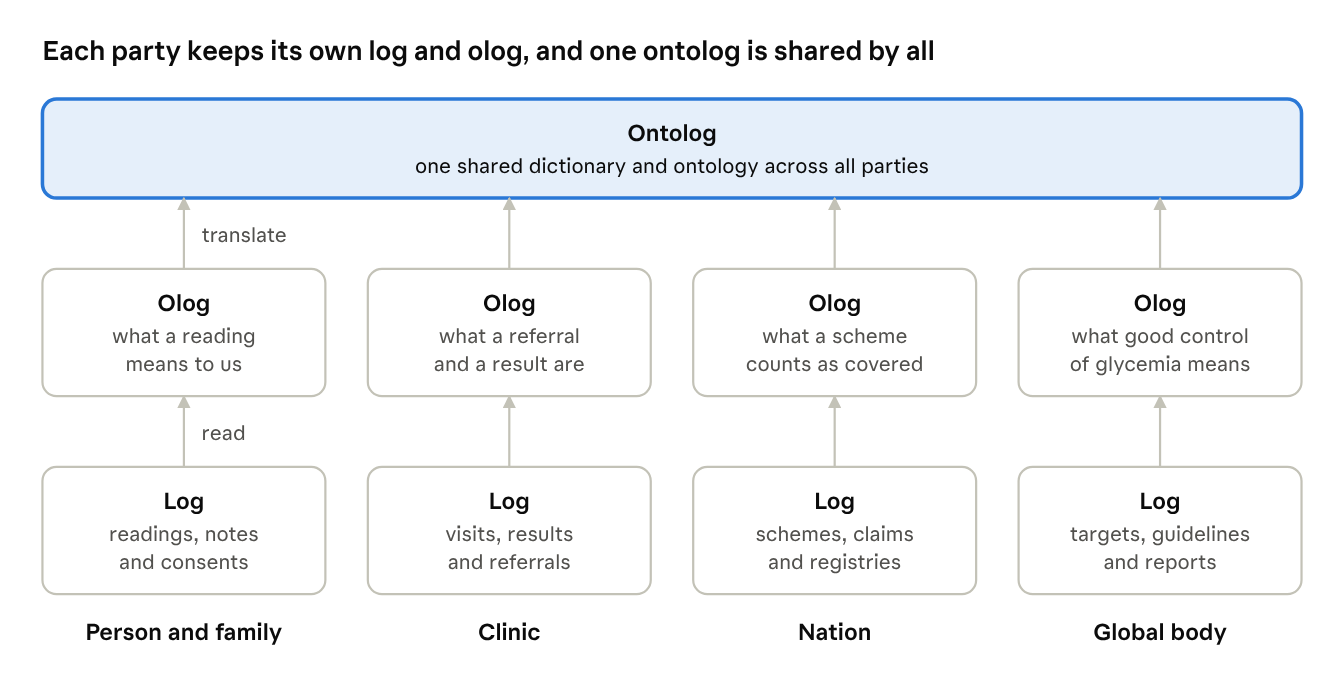
Each party writes only to its own log and reads its own olog from it. The ologs meet in the shared ontolog, which grows by additions like everything else.
The same three layers run through the 2014 matrix. Row 3 imagined flat dictionaries whose unknown values point into another dictionary, which is an ontolog grown one reference at a time. Row 4 was semiotics, the study of signs that Roland Barthes, and Baudrillard after him, read for the social power that signs carry. Rows 10 to 12 went from collaborations close at hand, to marketplaces that democratize innovation further out under the heading of SocioWare, to equivalence in theory and in practice, which is the question of when two parties mean the same thing. Twelve years on, those rows read like a caption for the drawing above.
Each layer also lines up with one of the readings. The log is Husserl's sedimentation with reactivation built in, since anyone holding a signed entry can trace it back to whoever signed it. It is Derrida's writing as well, and the signature is the trace that stays attached after the record leaves home. The ontolog is a symbolic order in Lacan's sense, the big Other written down as a shared dictionary, which brings Žižek's diagnosis straight into the design.
Sociology has names for the same layers. A signed entry is what Bruno Latour called an immutable mobile (1986), an inscription that can travel, be copied and be combined with others and still arrive unchanged. The ontolog is a boundary object in Susan Leigh Star and James Griesemer's sense (1989), plastic enough for each party to use in its own way and robust enough to keep one identity across all of them. Keeping an olog is the classification work Bowker and Star describe, and a confirmed reading on its way to a national figure is Porter's trust in numbers, with a signature attached.
The same layers are where Unified Knowledge Access & Distributed Intelligence started: one persistence layer of immutable facts, which each application projects into its own domain model through one shared ontology. The logs are that layer, kept by each party and signed. The ologs are the projections, and the ontolog is the shared ontology, grown by addition like everything else.
Retrieval pipelines fit on top of these layers as well. Put one there and it does what RAG already does, fetching by content and assembling a context for one or more models, with every fetched entry arriving under its signature and with its olog's account of what it meant to the party who wrote it. The ontolog then carries part of the translation that embeddings approximate, as declared equivalences between the parties' terms, which is the matrix's row on equivalence put to work. Retrieval by content grows into retrieval by content and origin. Reactivation stays one hop away, at whoever signed, and whatever the models write from that context goes back into a log as one more entry, signed by whoever vouches for it. The clipboard from Amnesiac APEs grows into the shared memory it asked for, with a signature on every entry.
Can a shared order hold together after its decline? The answer this text puts forward is that the ontolog can grow the way the logs do, one co-signed addition at a time, with its authority coming from the parties who added to it.
Only Adding
Every reading so far has circled the same question, how meaning survives being handed on, and monotone collaborations answer it with the most modest rule available: only add.
A collaboration is monotone when nothing a party learns later can take back something it already concluded. Collaboration Is Composition made this precise. Each party is a box that reads a log of signed records and produces outputs. Monotonicity itself is one condition: more records never take outputs away. The paper's monotone box adds two conventions that keep the model tidy: feeding a box its own outputs tells it nothing new, and a box that has seen only its starting log says nothing at all.
$$L \subseteq L' \implies \mathrm{Out}(L) \subseteq \mathrm{Out}(L') \qquad \mathrm{Out}(L \cup \mathrm{Out}(L)) = \mathrm{Out}(L) \qquad \mathrm{Out}(L_0) = \varnothing$$
The CALM theorem from distributed systems explains why the first condition matters: a problem has a consistent implementation without coordination exactly when it is monotone. Joseph Hellerstein conjectured it, Tom Ameloot, Frank Neven and Jan Van den Bussche proved it for networks of relational transducers, a formal model of distributed queries, and Hellerstein and Peter Alvaro's "Keeping CALM" (2020) gives the general account. Collaboration Is Composition proves its own form of the result, in Lean, for boxes over signed records. Parties that only add can each work at their own pace, receive records in any order and still end up agreeing, because every new record moves everyone in the same direction. Nobody has to keep them in step. Where an orchestrator is still useful, it joins as one more collaborator, with its own log and its own signature.
Some steps can't be written as additions. They depend on something being absent: no one has objected, this is the latest version, the slot is still free. The same paper proves that such a step can come out differently under two fair delivery orders, so it needs coordination. The model asks for that coordination as a co-signature: a receipt signed by both parties, or a timestamp signed by a witness they share, which fixes the order. Each such step marks the place where the parties settle it together, on the record. The non-monotone remainder ends up small, visible and co-signed.
That is what distributed self-organization via monotone collaborations comes to. Order forms out of additions that are safe wherever they land, plus a few co-signed or witnessed decisions at the points where absence matters. It describes how such an order could form, and leaves what each node values to that node.
Every system that keeps records sediments, and how far reactivation can reach depends on who holds the layers. On a gated platform the codes and the weights stay with the platform, which can rewrite both whenever the quarterly numbers ask it to. In a monotone collaboration every layer is signed and kept by the parties who wrote it, so anyone holding the records can dig back down through them and redo the seeing.
Baudrillard's final phase arrives here too. A model can still write a record of an event that never happened. In a monotone collaboration that record joins the log like any other entry, carrying the signature of whoever chose to vouch for it, and the signature says exactly who to ask.
From Anarchitecture to Socioware
In Anarchitecture (2020) I went looking for a way to run post-agile, managerless teams. Fred George's "programmer anarchy" supplied the attitude, a functional core inside an imperative shell of plugins supplied the architecture, and Conway's law tied the two together: an organization ends up designing systems shaped like its own communication. A reader suggested "goodwillchitecture" instead, and I answered with contractualism and with anarchism understood as non-coercive consensus.
Six years on, each piece of that essay has grown into a piece of the socioware described here:
- the functional core has become a core of discrete mathematics and signed records, with every box a monotone function of its log;
- the plugins have become parties, wired to one another through mailboxes;
- emergent leadership has become authority that follows from what a key is allowed to sign, and the orchestrator has become one more collaborator;
- the manager outside the technical chain has found its large-scale counterpart in the gated platform, which sits outside every chain it serves and still sets the terms.
Non-coercive consensus carries over intact. A signature is consent turned into a record, given by a party who could have withheld it, and a monotone collaboration is a consensus that grows by such records. Conway's law scales up along with it. Societies that collaborate through signed, additive records would end up with systems shaped like that collaboration: many logs, many ologs and one ontolog, grown by addition.
Anarchitecture ended on the solution emerging from the problem definition itself. Meaning can emerge the same way, from records that only add, signed and shared by those who were there. What could such a socially aware tooling be called? Once again, the answer comes from the question itself.
We could call it socioware.
Readings
- Edmund Husserl, Logical Investigations (1900 and 1901).
- Edmund Husserl, The Crisis of European Sciences and Transcendental Phenomenology (written 1934 to 1937), trans. David Carr (1970), with "The Origin of Geometry" (1936).
- Martin Heidegger, Being and Time (1927), trans. John Macquarrie and Edward Robinson (1962).
- Martin Heidegger, "The Question Concerning Technology" (1954), in The Question Concerning Technology and Other Essays, trans. William Lovitt (1977).
- Jacques Derrida, Edmund Husserl's Origin of Geometry: An Introduction (1962), trans. John P. Leavey Jr. (1978).
- Maurice Merleau-Ponty, "Eye and Mind" (1961), trans. Carleton Dallery, in The Primacy of Perception, ed. James M. Edie (1964).
- Jorge Luis Borges, "On Exactitude in Science" (1946).
- Roland Barthes, Mythologies (1957).
- Jean Baudrillard, Symbolic Exchange and Death (1976).
- Jean Baudrillard, Simulacra and Simulation (1981), trans. Sheila Faria Glaser (1994).
- Jean-François Lyotard, The Postmodern Condition: A Report on Knowledge (1979), trans. Geoff Bennington and Brian Massumi (1984).
- Jacques Lacan, "The Mirror Stage as Formative of the I Function", in Écrits (1966).
- Jacques Lacan, The Four Fundamental Concepts of Psychoanalysis, Seminar XI (1973), trans. Alan Sheridan (1977).
- Slavoj Žižek, The Ticklish Subject (1999), ch. 6, and Welcome to the Desert of the Real (2002).
- Max Weber, The Protestant Ethic and the Spirit of Capitalism (1905), trans. Talcott Parsons (1930).
- Alfred Schutz, The Phenomenology of the Social World (1932).
- Peter Berger and Thomas Luckmann, The Social Construction of Reality (1966).
- Harold Garfinkel, "'Good' Organizational Reasons for 'Bad' Clinic Records", in Studies in Ethnomethodology (1967).
- Jürgen Habermas, The Theory of Communicative Action, vol. 2 (1981).
- Bruno Latour, "Visualisation and Cognition: Thinking with Eyes and Hands" (1986).
- Susan Leigh Star and James Griesemer, "Institutional Ecology, 'Translations' and Boundary Objects" (1989).
- Theodore Porter, Trust in Numbers: The Pursuit of Objectivity in Science and Public Life (1995).
- Geoffrey Bowker and Susan Leigh Star, Sorting Things Out: Classification and Its Consequences (1999).
- David Spivak and Robert Kent, "Ologs: a categorical framework for knowledge representation" (2012).
- Melvin Conway, "How Do Committees Invent?" (1968).
- Fred George, "Programmer Anarchy", talk at GOTO Aarhus (2011).
- Tom Ameloot, Frank Neven and Jan Van den Bussche, "Relational transducers for declarative networking" (2011).
- Joseph Hellerstein and Peter Alvaro, "Keeping CALM: when distributed consistency is easy" (2020).
- Patrick Lewis et al., "Retrieval-augmented generation for knowledge-intensive NLP tasks" (2020).
- World Health Organization, First-ever global coverage targets for diabetes adopted at the 75th World Health Assembly (2022).
- Risav Karna, Anarchitecture (2020).
- Risav Karna, Amusing our Devs to Death - I (2020).
- Risav Karna, Time - I: A semantic crisis (2020).
- Risav Karna, Time - II: An existential crisis (2020).
- Risav Karna, Unified Knowledge Access & Distributed Intelligence (2026).
- Risav Karna, Amnesiac APEs Wearing RAGs (2026).
- Risav Karna, Collaboration Is Composition: Mealy Machines over Signed Records in Poly and Org (2026).
About the author
- Technical Leadership & Architecture
Comments
Join the discussionNo comments yet. Be the first to comment.
Unified and Decentralized
Large scale knowledge engineering and unified data access architecture for distributed intelligence and data sovereignty.